



“I’ve never done things the easy way,” chuckles Ray Palmer, now 77, of Winnipeg. And so it was, when a bout of pneumonia eventually led to a diagnosis of idiopathic pulmonary fibrosis (IPF) in 2020, just as the pandemic was unfolding. A diagnosis of the auto-immune condition Sjögren’s disease six months later, only added to his challenges.
It took a while for the IPF diagnosis to sink in, he says. His wife Jo-Anne, struggled with anxiety in those first few months after Ray’s diagnosis, but a month of counselling “helped me put things in perspective, and Ray’s positive attitude is very helpful,” she says.
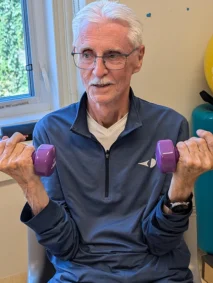
When pandemic restrictions eased, Ray was able to attend a pulmonary rehab program twice a week one summer. “I learned so much,” he says. In addition to breathing exercises and other physical activities, we learned about nutrition, medications and various coping strategies. “Complaining doesn’t help,” he says. “A positive attitude makes a huge difference.”
Both Jo-Anne and Ray say that the medical care Ray has received has been absolutely incredible. His respirologist and immunologist (who deals with his Sjögren’s disease) are in regular contact about his treatments for the two conditions. And, of course, his GP is also informed. He did try anti-fibrotic medication, but could not deal with the side effects.
Sjögren’s presents daily challenges
For most of the past five years, Ray’s PF has been fairly stable. It’s his Sjögren’s disease that gives him the most day-to-day trouble. “It’s just really in your face,” he says. And Jo-Anne reports that when the Sjögren’s is bad, his PF is worse, with more coughing, fatigue and breathlessness.
Sjögren’s is an auto-immune condition characterized by dry eyes and dry mouth. In Ray’s case, he experiences “burning mouth” syndrome as a symptom of the disease. Things also taste different to him; for instance, chocolate, a favourite, now tastes like cinnamon. And, “mint is just painful. No mint-flavoured toothpaste or anything,” he says. In addition, tooth decay is more rapid and the dry eyes can affect your vision.
Medication crisis
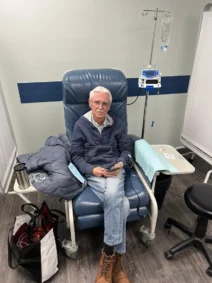
Things changed dramatically late last year, when Ray stopped taking mycophenolate pills and received an infusion of rituximab, a new medication for his Sjögren’s. He did not respond well and his PF flared up. In January, he was coughing and very short of breath all the time. And he lost 30 pounds very rapidly. “We weren’t sure if he was going to make it for a bit,” says Jo-Anne.
After an emergency visit to his respirologist, Ray was put on prednisone and is now doing well. The crisis brought home to the couple the need to “get their affairs in order” and prepare an advanced care health plan. “Despite the high emotion at the time, afterwards, we were very practical and took the necessary steps for peace of mind,” says Jo-Anne.
During Ray’s recovery, Jo-Anne fell and broke her right wrist. They joke about what a fine pair they are, and how they need to cooperate now to do the things that they used to do individually.
A great support network is so important
Ray and Jo-Anne are fortunate that they live in a totally separate unit within their son and daughter-in-law’s home. “They are very supportive when we need it, but we live quite independently,” says Jo-Anne. “And we have fantastic family and friends. When Ray was bad, we had a zillion people drop off prepared food for our freezer and keep in touch. It’s so important to have someone to talk to – and to hug – when you need it.”

Jo-Anne found CPFF on Facebook and she and Ray took part in the first CPFF Walk in Winnipeg, which had a great turnout. She’s also attended the Caregiver’s Support Group. CPFF and its support groups can be a great resource for information and for those who don’t who don’t have a social network, says Jo-Anne.
For now, Ray and Jo-Anne are feeling good and feel fortunate they have what they need. “We have good days and bad ones, but we take it one day at a time, and with a positive attitude, we get through it,” says Ray.