



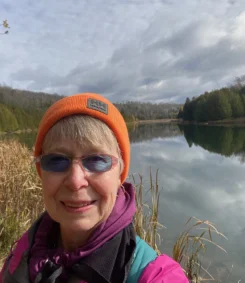
“I truly hope I stay healthy enough to complete the Bruce Trail with my daughter,” says 73-year-old Angie Finkel of Toronto. Diagnosed with ILD in 2018, during the past several years, she has been able to walk half of the Bruce Trails’ 900 km route, which stretches from Queenston Heights in Niagara to Tobermory in the Bruce Peninsula. (Not all at once, but in 10-12 km outings.)
Early symptoms
Like many others, Angie’s first symptom of pulmonary fibrosis was increased difficulty breathing. Before her diagnosis, she remembers the difficulty she had on a hiking holiday in Ireland. “One of our hikes involved a lot of stairs leading to a viewpoint over a lake. I had to drop out, I was so out of breath. The hike leader told me that being so out of breath was not normal. At the time I was angry about her comment and that she would not wait for me. Looking back now, I see it was a warning that things were not right.”
Angie was also concerned because family members on both sides of her family had a history of pulmonary fibrosis, including a cousin who had a lung transplant due to IPF and asbestosis and her father who had IPF. She followed up with her GP, who referred her to a cardiologist, because she also experienced chest pain with her shortness of breath. When her heart proved healthy, the cardiologist referred her on to a respirologist.
Diagnosis
She had a CT scan and the report indicated she had interstitial lung disease (ILD). She asked the respirologist if ILD, a term she was not familiar with, was related to IPF. He said she didn’t have anything to worry about and that she would not want to take either of the two available medications because of the side effects.
As a retired nurse, she did her research and asked for a referral to the ILD clinic at University Health Network (UHN) in Toronto. They did a work up and after a team consult, decided to follow her case; first every four months, and then every six months. After five years of stable results, her clinic visits were reduced to once a year.
In those early days, Angie attended the UHN support group and connected with others in the group, including Barbara Barr (who has passed away) and Jeannie Tom, who were very encouraging.
A passion for walking
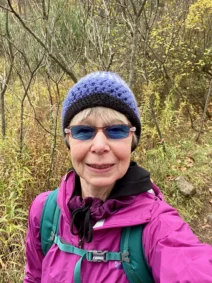
In the meantime, Angie continued to pursue her passion for walking and hiking with several groups. Some groups get together for 10 km walks through the city, and others do more adventurous hikes through ravines and hills. Angie is now a walking group co-leader, planning and leading walks every other week.
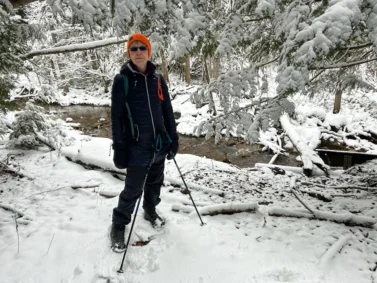
“It’s a great activity on many levels,’ says Angie. “We exercise, get out in the fresh air and nature, and we socialize, stopping afterwards for coffee and to eat.”
Disease progression after a long, stable stretch
Very gradually though, Angie has noticed that she needs more rest breaks, sometimes even on more level walks. This spring, her annual clinic check revealed a nine per cent decline in her breathing test (Forced Vital Capacity FVC).
“The result was a blow,” she says. “I’ve been stable for so long, I just expected them to tell me I was fine, as usual.” She’ll go back again in November for a re- assessment. If the result still shows a decline in her FVC, her doctor will discuss starting anti-fibrotic medication.
“It briefly sent me back to the days of my initial diagnosis, when I was planning my demise. But, now I am better equipped, better informed.” Angie follows several Facebook sites and websites, including those of CPFF.
What advice would she give others?
“Given the unpredictability of ILD, try to figure out what is most important to you and focus on that. That will help you live your best life, because you never know what the future brings.”
Angie is determined that her future will include completing the remaining 450 kms of the Bruce Trail. To that end, she’d welcome responses from CPFF Facebook followers to her post of August 25, about hiking with portable oxygen.