

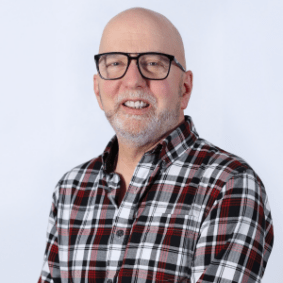
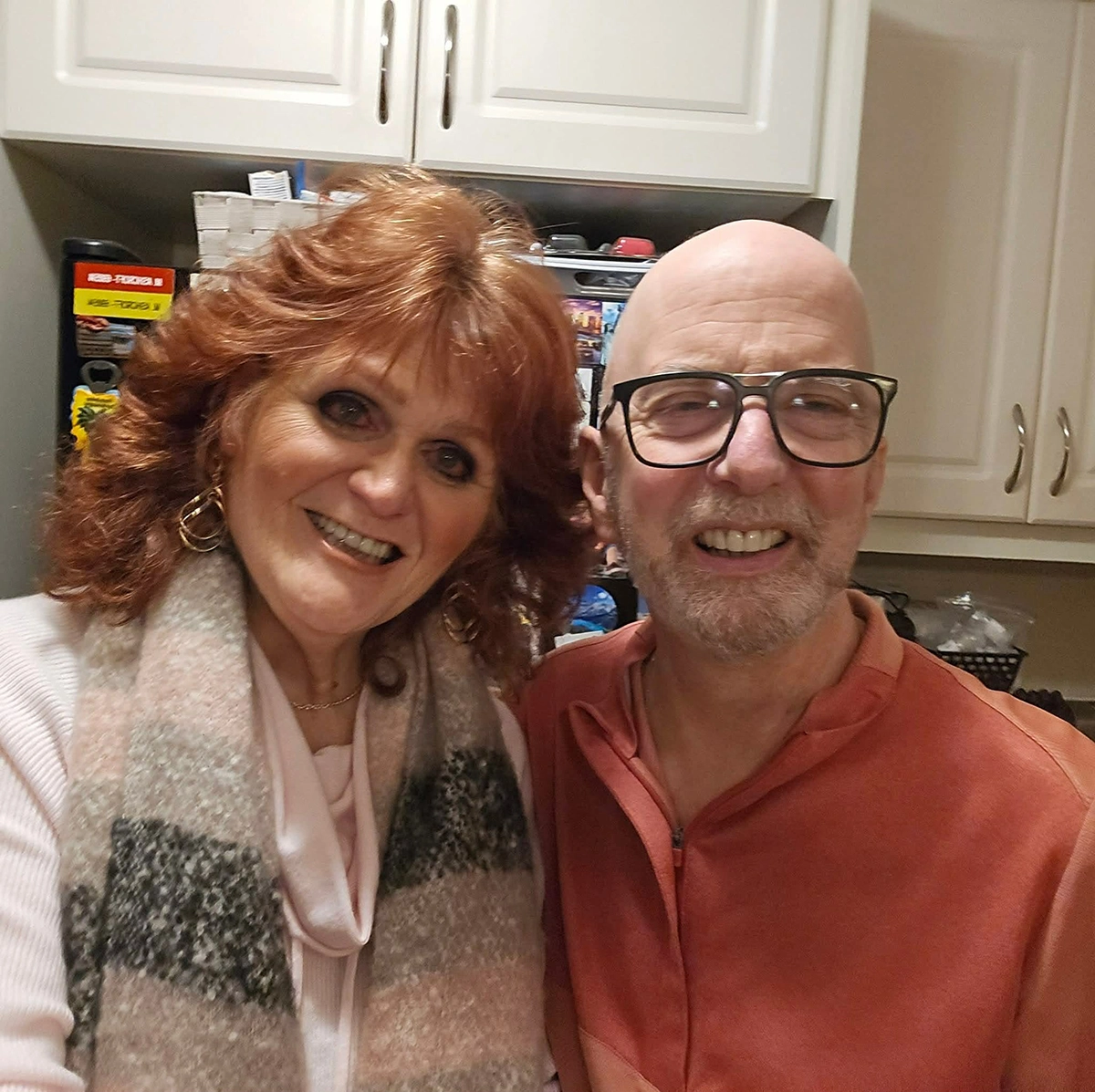
Mark Ashcroft is using his personal experiences from a career in community health and safety services, as a patient, a transplant recipient and as a Board member to help CPFF help you.
Mark Ashcroft is a listener and he’s been where you are. He understands community organizations and board responsibilities – he is, and has been, a member of several, including five years on the CPFF Board. He’s able to get people working together in the same direction, in a calm and thoughtful manner. People respect him and his experience; and he respects their views and ideas.
Transplant recipient Mark Ashcroft joins Dr. Scallan in this video, providing the patient perspective.
Mark and Maxine Ashcroft join Brenda Reynolds in this video about their unique transplant experiences from the patients and caregiver perspectives.
Mark has a few goals for CPFF
During his two-year term as Board Chair, which began in January 2026, Mark has a few goals he hopes to help CPFF achieve:
- He’d like to see at least a few provinces ensure that every person with pulmonary fibrosis gets the oxygen they need, when they need it.
- He’d like CPFF to broaden its donor base, both geographically and to include more corporations.
- He wants CPFF to keep providing hope to the PF community by continuing to invest in research through the Robert Davidson fellowship program, which trains ILD specialists, increasing access to these professionals.
Equitable access to oxygen
“Access to oxygen therapy varies so much across the country, and even within provinces,” he says. “It needs to be available to everyone who needs it. We’re talking about breathing. It shouldn’t matter where you live. We all need to breathe.
“That includes liquid oxygen,” he says. “Those who need a high-flow of oxygen on exertion, need liquid oxygen, otherwise they are virtually housebound, and that’s no way to live,” he says.
He knows this from personal experience. Diagnosed in 2018 with ILD, an acute exacerbation in 2021 changed his life dramatically. He lost 50 per cent of his lung capacity within two months, had to go on oxygen and underwent a lung transplant assessment at Toronto General Hospital.
He was very reluctant to go on oxygen therapy. “I saw it as giving up. I thought I can’t possibly need this. I can manage.” When he finally started using oxygen, he realized he should have done it earlier. “Life was just so much easier. I could walk and do other things without struggling,” he says.
Financial stability
In addition to equitable access to oxygen, Mark would like CPFF to maintain and grow it’s donor base to maintain its financial stability and health.
“We’ve done remarkably well, in these very challenging economic times, to increase our revenues. Especially as a smaller, lesser- known charity, supporting a rare disease,” says Mark. “I’m grateful to everyone who has made a donation, or volunteered, and the CPFF team who have worked so hard to get us where we are today.”
He’d like to see the organization increase it’s outreach in the Maritimes and to broaden the donor base to include more corporations. “I know it’s difficult; as a charity for a rare disease, we cannot offer large firms the exposure of a heart and stroke or cancer charity, or a children’s charity,” he says. “But we should be able to connect with some companies through our local relationships.”
CPFF Board experience
In his five years as a CPFF Board member, Mark has been the Chair of each of its committees, leading the volunteer Board members on the Governance and Finance and the Advocacy, Fundraising, Communications and Support committees, as they have changed and merged.
“I’m quite proud of the work CPFF did to have nintedanib added to all of the government formularies for all types of progressive PF, in addition to IPF,” says Mark.
And although it was not a CPFF advocacy initiative, Mark comments on the recent policy change that means patients no longer need to be re-tested each year to continue to receive oxygen therapy. “It’s a change that just makes sense. People are not going to get better without it and re-testing is just another barrier to access.”
From exacerbation to transplant journey
It wasn’t long after Mark joined the CPFF Board, when he experienced the acute exacerbation in the fall of 2021 that severely affected his health, reducing his lung capacity by 50 per cent.
Until then, Mark was living fairly normally with ILD. Afterwards, “I would have severe coughing fits for 30 minutes or more, and it would be hard to catch my breath,” he says. “Sometimes, I’d go downstairs and shut the door so I didn’t disturb Maxine (his wife). It was tough on her, when I was so sick. I wasn’t able to do much.”
Mark was referred to the transplant team. After the lengthy assessment process, Mark was accepted onto the transplant list at Toronto General Hospital (TGH). When asked about his decision, he says: “There was really no decision to make. I was 61 years old and if I didn’t have the transplant, I would die.” Maxine and their daughter Jessica were on board. Mark had a brother who died of PF at age 41 in 1997.
Mark dealt with two “dry” runs, which is when you are called in for a transplant that doesn’t happen. “The first time, the lungs were not suitable and the second time, I tested positive for COVID. These dry runs were something I had not expected and were difficult experiences for our family.”
He finally received a double lung transplant in January 2023. He left the hospital 10 days later – quite a remarkable recovery. Another of Mark’s brothers, had a double-lung transplant in December 2024, but spent six months in hospital after his surgery.
Setbacks and accommodations

Left to right Maxine and Mark Ashcroft, Sharon Lee (CPFF CEO) and Debbie Homik (CPFF Winnipeg Support Group Leader)
But, there were setbacks to come for Mark too. A month after his return home, all of a sudden, he couldn’t breathe and his oxygen was down to 82. It was the first time he was at home alone. He still had oxygen at home (as recommended for six months post-surgery), so he was able to call an ambulance to take him straight to TGH. He spent 19 days in hospital fighting organ rejection.
Later, he got CMV, a common type of herpes infection, that about 50 percent of the population has dormant in their system and is routinely overcome by most people with a healthy immune system. It took months for him to fight it, to find the right balance of drugs to fight the infection and those he needed to keep organ rejection in check.
Last fall, it took him seven weeks to fight off a viral infection, and this spring he was in hospital for eight days fighting off RSV (respiratory syncytial virus). This year, he has developed cataracts, likely from continued prednisone use, and will need surgery to remove them.
Mark undergoes regular monitoring, with weekly bloodwork and does a daily home spirometry (breathing) test and takes his vitals, which he submits weekly. Once a month he visits the transplant clinic. In addition to PF, he also developed celiac disease, an auto-immune condition in 2018.
“I have a lot of doctors and health care professionals,” says Mark. An immunologist when viruses strike, a haematologist (blood specialist), the many members of the transplant team, his GP and his local respirologist that he still sees once a year. “They are all amazing and I’ve received the best care.”
All in the family
Although Mark spent much of his working life with emergency medical services and with Toronto fire services, his two brothers who also had pulmonary fibrosis were not firefighters. Mark is the youngest of four brothers, and only one, has not been affected by PF.
“We’ve been able to trace this trait in our family back to a maternal grandmother, who passed away at a young age,” says Mark. Mark has undergone genetic testing, which may reveal more information, when he gets the results next month. Those results may be of interest to his daughter Jessica, and her daughter Aria, who is just two years old.

Life is good
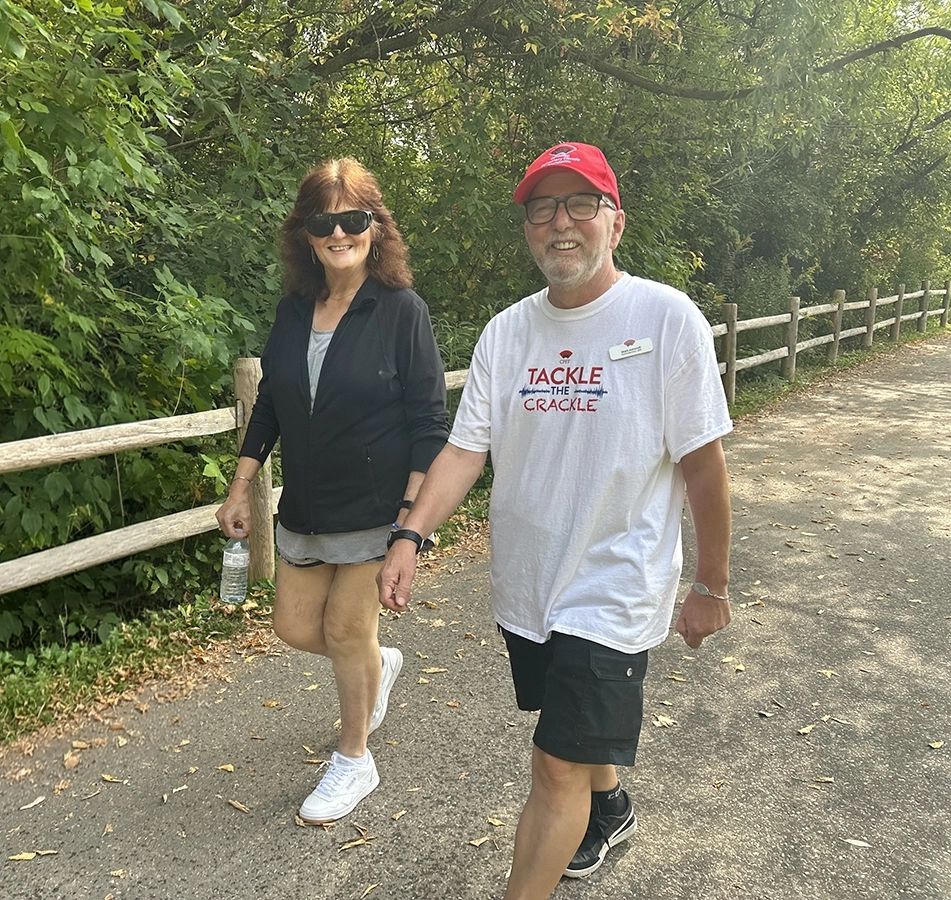
Overall, Mark insists “life is good. I can’t do everything I did before I had PF, but I play softball in the summer and curl in the winter. And, I can do most of the yard work – it just takes me longer. And, most Saturdays, Maxine and I visit our granddaughter in Toronto.”
Since retiring in 2018, Mark has been involved with the Boards of several community organizations. He noticed the call for CPFF Board members in 2020 and joined up in 2021. Since his transplant, he’s slowly trimmed back on some of his other volunteer work, and stepped up his involvement with CPFF, becoming Chair of the Board this past January for a two-year term.
“I like to be involved in something with purpose. I don’t just want to sit around,” he says. “I like to help people and make a contribution.” Of course, that’s something he’s been doing for decades with EMS and Toronto Fire Services, where he eventually became the acting deputy chief and a training officer. He retired as a professor of the pre-fire program at Seneca College.
He does admit to slowing down a bit. “With all the transplant meds – 30 pills a day – you do get a little run down. Most days I have a nap. When I’m at meetings for several days, I’ll often sneak away for a nap during the day.”
A thoughtful leadership style
In person, and on Zoom meetings, Mark is mainly a listener. When he does speak, everyone listens; others respect his views and experience. He, in turn, respects the views and perspectives of others. He contributes in a thoughtful manner with comments that make sense.
As a leader, Mark is able to bring others to a consensus that they can agree to support. He is dedicated and diligent. These are all qualities we can applaud in our new Board Chair. And, if you happen to see him at a CPFF event, feel free to talk to him about your concerns and ideas. He listens!