


He may not climb mountains anymore, but he still golfs

It’s not unusual for people living with auto-immune conditions such as rheumatoid arthritis or scleroderma to develop pulmonary fibrosis if their disease progresses and affects their lungs.
In Dave Rasmussen’s case, a diagnosis of idiopathic pulmonary fibrosis (IPF) came first. It was followed by a diagnosis of Sjögren’s syndrome, an auto-immune condition characterized by dry eyes and dry mouth, and eventually he developed rheumatoid arthritis (RA), another auto-immune condition.
Getting diagnosed
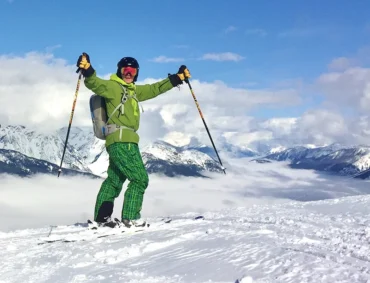
Like many other PF patients, it was a constant cough in early 2013 that lead Dave to seek medical attention. His family physician described his breathing sounds as “crackles” and suspected pneumonia and sent him for a chest x-ray. Antibiotics did not remedy his cough.
A referral to a pulmonologist confirmed IPF later that year and in 2014 a rheumatologist diagnosed him with Sjögren’s syndrome, and a lung biopsy confirmed the diagnosis.
“My wife Shelly, and I got on the internet after the IPF diagnosis and were shocked by what we read,” relates Dave. “It was scary. I tell others NOT to do this, it will only upset you.” They chanced upon the CPFF website and the PFF website in the US and finally found some reliable information.

Why me? It could start with your genes
“I kept asking why me,” says Dave. “ I was very active, ate right, played sports. I couldn’t understand it.” Upon reflection, it may begin with his family history. Dave has lost three siblings, two of them to an auto-immune disease and/or pulmonary fibrosis.
- His brother Brian was misdiagnosed for three years. Upon his eventual IPF diagnosis, he was fast-tracked for a lung transplant, but died two months later, aged 62 in 2017.
- His younger sister Janice had a rare blood disorder and passed away, aged 56 in 2019.
- Another sister Barbara passed away from PF secondary to rheumatoid arthritis, which she developed at age 15. She later developed Sjogren’s disease. In early 2022, she suffered two bouts of pneumonia and passed away, aged 64 in April of that year.
Hiking mountains to raise funds
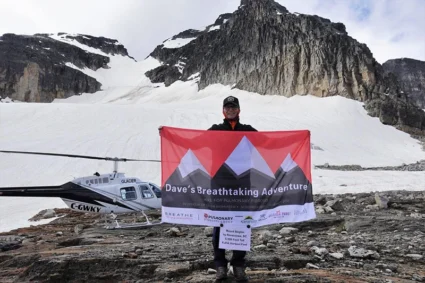
On June 2, 2018, Dave went on the first of three planned mountain hikes as a fundraiser for PF and to honour his brother. Just shy of 200 feet from the top of the mountain, he could no longer get a reading on his oximeter because of the cold, wet weather. He had to stop. “When I got home, I went to see my doctor about hiking 20 km on the road, instead of a mountain trail, and he said ‘No,’ and laughed because he knows how I push myself.”
Dave’s journey continues
Six years after his initial PF diagnosis, Dave took a six-week pulmonary rehab program and started taking pirfenidone. He increased the dosage gradually over five months to the maximum and suffered only mild headaches in the early days. He also continued to manage the dry mouth and dry eyes of his Sjogren’s syndrome.
In 2022, he experienced an acute exacerbation of his PF. Dave was admitted to hospital with an oxygen saturation of 79 per cent. After a high dose of antibiotics, prednisone, and plenty of tests, he went home with a high-dose prednisone prescription. “It took me about three months to recover and I lost about two per cent of my resting oxygen saturation.”
In June of 2024, it was his joints that needed attention. Starting with wrist pain and swelling in a couple of toes and fingers, by October, despite pain medication, the pain was “unbearable,” says Dave. “I could hardly get up from a chair, or out of bed, and stairs were very difficult.”
His rheumatologist confirmed that he now had rheumatoid arthritis (RA) and Dave began taking a weekly injection of Methotrexate, hydroxychloroquine and folic acid for the RA, as well as prednisone for the inflammation for two months. During this time, his lung function tests declined, he lost weight and he could not exercise. He has since recovered from this RA flare up.
How he’s doing today
Overall, Dave realizes he is fortunate that his PF has not progressed quickly during the past 12 years. His resting oxygen saturation is 95 per cent. While he no longer hikes in the mountains, skis or plays hockey, Dave manages fine with his day-to-day activities. He still golfs weekly during the summer and is planning a golf vacation in B.C. this June. Shelly is his main support person, but has not had to become his primary caregiver. Although she does “keep a closer eye on me these days,” says Dave.
Dave regularly visits the CPFF private Facebook page: Canadians Living with Pulmonary Fibrosis. He encourages others to find out all they can about their disease from reliable online sources such as www.cpff.ca. And he is happy to share his experiences with other patients and direct them to accurate information sources.
Dave advises others to consider the following:
- If you can tolerate them, take the medications that help your condition.
- Do what you can in terms of diet and exercise to stay as healthy as you can.
- Wear an N100 mask to protect yourself if you’re out in a crowded, public space and around sick family.
- Be positive as your mind is a very powerful healer.
- Tell others about pulmonary fibrosis. The more people who know about this disease, including health care workers, the more support we can get for the cause.
- Most importantly, enjoy your life while you can. Do the things you love, even if you have to do them a bit slower.