


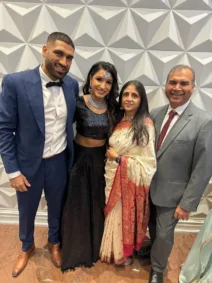
Throughout her PF journey she was a source of light for others
Just days before she passed away on November 26, 2025, Varsha Desai, 61, learned the gender of her first grandchild, expected this spring. She is still the only one who knows.
“I held up my phone for her, so she could click on the icon to reveal the baby’s gender,” says her son Nilay Desai, 36, who had come from California with his wife Jaspreet, to visit his mother in hospital. “No one else knows, even my wife and I, but I wanted my Mom to know.”
The diagnosis
Like most people with pulmonary fibrosis (PF), Varsha went to her family physician in 2019 with a dry cough and throat clearing that wasn’t going away and some shortness of breath. A chest x-ray led to a referral to a pulmonologist, who ordered a CT scan. It took some time, with the pandemic in full force, but Varsha eventually came under the care of Dr. Matthew Binnie at the Toronto General Hospital Interstitial lung Disease (ILD) Clinic.
Varsha’s HRCT scans did not show the typical patterns for idiopathic pulmonary fibrosis (IPF). Her first diagnosis in 2021 was nonspecific interstitial pneumonia or NSIP and she was initially treated with the immunosuppressant mycophenolate.
The family reactions
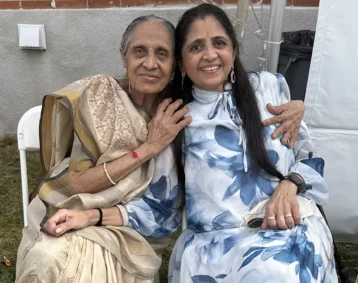
Her daughter Shivani, 31, is a physician and she was surprised by the diagnosis. At the time she was doing her residency in New York. “What I learned in medical school about pulmonary fibrosis was very limited. Still, I did know that she didn’t have any of the risk factors. She was never a smoker or exposed to second-hand smoke or chemicals. There is no family history. She had no other health conditions or took any prescription medications.
“It just seemed to come out of the blue. And, even knowing what I do, I just kept thinking this can’t be happening to her.”
Nilay, was also taken aback. “I’d never heard of this disease. I didn’t really take it all in. She seemed to be perfectly fine.”
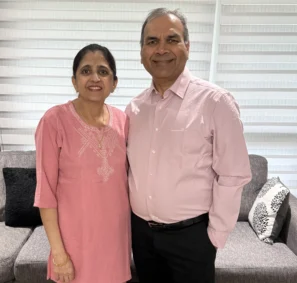
For a few years, Varsha was quite stable. She kept working, as did her husband Mitul. In good weather, Varsha walked to and from work. But, she was the one who alerted others to when she was in decline. “She was the one who would say: ‘I can’t walk up this hill anymore,’” recalls Shivani.
Shivani was regularly in touch with her mother and her medical team, as well as her father Mitul, who was his wife’s primary caregiver. He was the one to take Varsha to all her appointments. Looking back, he went with her to about 65 doctor appointments during the last three years, in addition to many lab and scan tests, says Shivani.
“With my brother and I living elsewhere, he was her main, daily, caregiver. He is very soft-hearted, we thought he would be the one to break down. But he was very strong, and did everything he could for her – for all of us.”
Another blow: cancer
In 2023, after a routine CT scan, a mass was found in the upper lobe of Varsha’s left lung. (Cancer is not uncommon in PF patients – watch our webinar on this topic.) The mycophenolate treatment was stopped and a lung biopsy was done.
A case was made for her to travel to Texas to receive proton beam radiation, which is not available in Canada. A more targeted type of radiation, it is often used on children, and in complex cases, when preserving as many healthy cells as possible is essential. She received approval for coverage of the treatment and spent two weeks in Texas in June 2024.
Varsha recovered well from the treatment and remained strong and optimistic about the future, says Shivani. “She just faced each obstacle one day at a time, and urged us all to do the same.”

The roller coaster of exacerbations and joyful memories
September 2024
Varsha stayed home for a month to recover and then returned to work. At almost three months post radiation, she was admitted to TGH with pneumonitis, with low oxygen levels, likely as a result of the radiation treatment. She was treated with high dose steroids and oxygen for three days, and gradually weaned off of both, with no side effects. She went home and back to work.
By this time she had been diagnosed with IPF and already started taking the anti-fibrotic, nintedanib. As the disease progressed, she was also placed on 24/7 oxygen therapy at home, limiting her daily activity. She had to stop working, but “she continued to live fully and quietly endured the progressive disease,” says Shivani.
Summer 2025
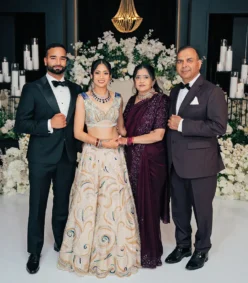
Shivani returned to Toronto and she and her mother prepared for her wedding to Harman on August 30, 2025. Varsha’s mother, Hansa Desai, who she hadn’t seen in more than four years, came from India for the event, as well as many other guests from the Toronto area and abroad.
“My Mom was involved in all of the preparations. I kept telling her to rest, but she kept saying she was fine,” remembers Shivani. “She never complained and was always focused on the well-being of others, especially her family. She was the one who was a source of comfort to those around her.”
The event gave her a chance to re-connect with friends and family. She even slowly walked and danced her way into the reception with Mitul and her oxygen. “She did it with such energy, all of our guests loved it, and her,” recalls Shivani.
Fall 2025
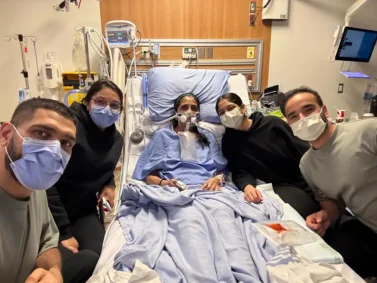
Unfortunately at the end of September 2025, Varsha began to have back-to-back acute IPF exacerbations, each worse than the previous one. Despite profound physical suffering and near-total loss of lung function, she was determined to get better and make it home from the hospital.
After almost two months of being in and out of the hospital, Varsha passed away on November 26th, 2025 surrounded by her family. “She was loved immensely and it showed as almost 50 of our family members and friends in the Greater Toronto Area came to visit her on her last day”, says Shivani.
Honouring Varsha
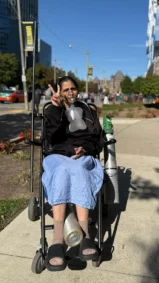
After her passing, funeral arrangements were made. Nilay’s sister-in-law, Raman, suggested that family and friends make a donation, rather than send flowers, to honour their mother. Shivani set up a fundraiser on Instagram and many family members and friends shared posts on their pages. They raised more than $5,000 and decided to send the donations to the Canadian Pulmonary Fibrosis Foundation (CPFF) to further research and help other patients and families dealing with the disease.
The siblings’ advice to others
“I wish I’d come to terms with my Mom’s illness earlier. I would have taken the time to appreciate various moments; taken more photos and videos; and asked all the questions I can no longer ask her,” says Nilay.
He also thinks it’s important for family members, or a friend, to research and get involved in treatment plans – to act as an advocate for your loved one. “Don’t hesitate to ask questions of the doctors and get a second opinion if you want it.”
Shivani urges others to spend as much time as you can with those you love, because you just never know what can happen. “My mother had good advice – try not to worry about what might happen, focus on what’s in front of you right now.”
Remembering and carrying on
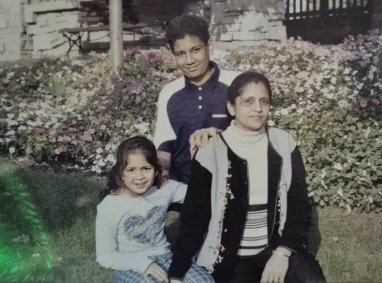
“It was just so easy to care for her, and about her. It was never a chore,” says Nilay. “Anyone in her position would have been forgiven for feeling overwhelmed, bitter or withdrawn. But she chose warmth, humour and a sense of normalcy instead. Even in her hardest days, she was still making us laugh.”
Since her passing, Mitul has travelled to visit temples in India with his sister and brother-in-law. Shivani writes that her mother’s “absence is felt deeply, but her legacy of love, resilience, and quiet bravery will endure forever.”
When Varsha’s first grandchild is born, there is no doubt her spirit will be delighted and sending her love to all of her family at such a joyful time.